

Motor vehicles are only allowed on public roads.
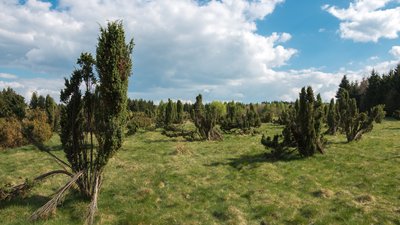
Wacholderheide Westernohe is a nature reserve in the Westerwald, preserving a unique open heath landscape. It protects rare plants like Arnica and Matgrass. Sheep grazing maintains the heath, preventing overgrowth and ensuring its distinctive flora thrives.
Wacholderheide Westernohe is an important nature reserve in Rheinland-Pfalz, established in 1967 to preserve a unique open heath cultural landscape. Its protection focuses on safeguarding rare plant species such as Arnica, Burnet saxifrage, Heather, and various Cinquefoils, which flourish here on nutrient-poor soils. Characteristic grasses, including the dominant Matgrass, Sweet vernal grass, Heath grass, and Cotton grass, define the area. The namesake Juniper bushes are found on about half of the reserve, contributing significantly to its special character. To prevent the area from becoming overgrown and to secure these valuable habitats, the heath is traditionally grazed by sheep twice a year and regularly mowed. This careful management ensures the preservation of biodiversity amidst the surrounding spruce forests.
| Location | Germany - Rheinland-Pfalz - Westerwaldkreis |
| Website | https://berichte.naturschutz.rlp.de/oneo/nsg/NSG-7100-032 |
| Area | 13.80ha |
| Year of foundation | 1967 |
| IUCN Category | IV |
| DtP ID | 27429a75-7175-4213-9433-8bf84ac9f084 |
| Name and division |
Stiftung Natur und Umwelt Rheinland-Pfalz
|
| Website | https://snu.rlp.de/ |
| Address |
Show address Hide address
Diether-von-Isenburg-Straße 7
55116 Mainz Germany |
Motor vehicles are only allowed on public roads.

Camping is forbidden.

Camping and bivouacking is forbidden.

Camping with vehicles and trailers is forbidden.

Fire is forbidden.

Cutting or injuring trees is forbidden.

Collecting plants is forbidden.

Collecting minerals and fossils is forbidden.


Photography and filming is forbidden at designated locations.
The following activities are specifically prohibited within the nature reserve: photographing and filming mammals and birds in their natural habitats in the wild.

Noise (tape recorders, players) is forbidden.