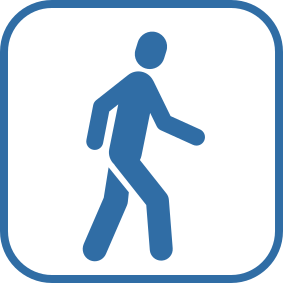

Entering is only allowed on paths and tracks.
The Möschelberg nature reserve near Lissendorf is located in the Vulkaneifel district of Rhineland-Palatinate, on the south-western edge of the Dollendorf limestone syncline.
Together with the neighbouring Burgberg, the area forms the south-western end of a series of limestone hilltops. The parent rock is dolomite from the Givet stage of the Middle Devonian. The hilltop stands out clearly from the surrounding, already eroded layers due to its weather-resistant dolomite rocks. The soils range from shallow rendzines on the slopes to base-rich brown earths at the foot of the slopes. The Möschelberg is characterised by semi-dry grassland (calcareous grassland), bushes and individual copses. Historically, the area was converted into an open hut through clearing and centuries of extensive pasture utilisation. This utilisation led to the formation of species-rich nutrient-poor grasslands, in particular Gentiano-Koelerietum, with numerous thermophilic and Mediterranean plant species. In some places, terraces from earlier arable farming are still visible, but are now covered with grassland vegetation again
| Location | Germany - Rheinland-Pfalz - Vulkaneifel |
| Website | https://berichte.naturschutz.rlp.de/oneo/nsg/NSG-7100-150 |
| Area | 16.22ha |
| Year of foundation | 1986 |
| IUCN Category | IV |
| DtP ID | 9dc0aa99-c481-425d-b5a6-8e60c73ee9b8 |
| Name and division |
Stiftung Natur und Umwelt Rheinland-Pfalz
|
| Website | https://snu.rlp.de/ |
| Address |
Show address Hide address
Diether-von-Isenburg-Straße 7
55116 Mainz Germany |
Entering is only allowed on paths and tracks.
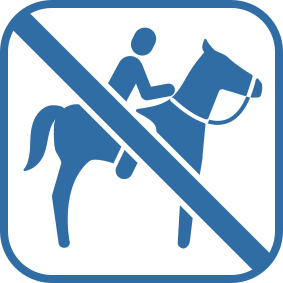
Horse riding is forbidden.

Motor vehicles are forbidden.

Overnight stays are forbidden.

Drones and model aircraft are forbidden.

Disposing of waste is forbidden.

Fire is forbidden.

Dogs on a leash are allowed.

Collecting plants is forbidden.

Photography and filming is forbidden.
It is prohibited to visit, photograph, or film animals at their nesting, breeding, living, or refuge sites.