

Entering is only allowed on paths and tracks.
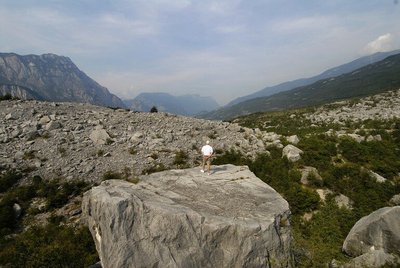
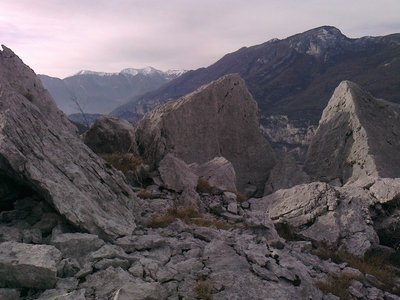
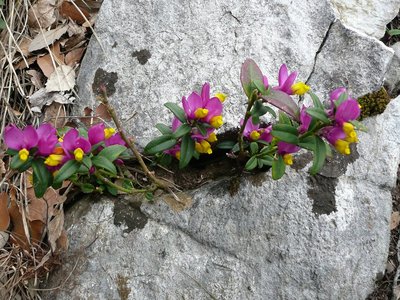
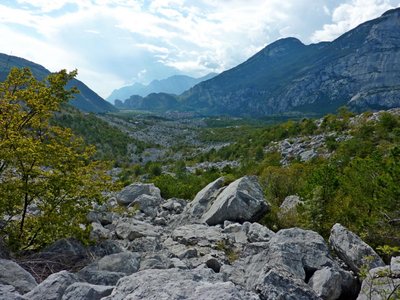
The nature reserve, accessible along the designated trail, has a distinctive and highly evocative, almost lunar appearance: large masses of huge rock blocks scattered chaotically across the landscape (the “marocche”). The characteristic vegetation is adapted to the area’s pronounced aridity and to the presence of a stony soil, very poor in humus. The reserve is also designated as a Flora-Fauna-Habitat area within the Natura 2000 network and is one of the protected areas that make up the Sarca River Park.
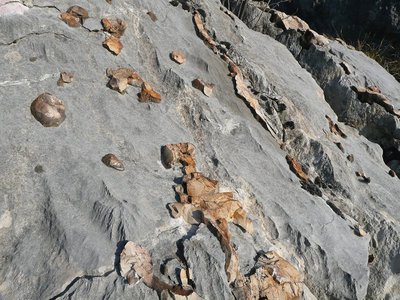
The origin of the “Marocche” is linked to the Ice Ages. In simple terms, when a glacier moves through a valley like a huge solid river, it also modifies its shape by exerting enormous pressure on its sides and floor. When the glacier retreats, fractured and loosened rock blocks and the exposed layers of rock are no longer supported by the mass of ice and break away, collapsing onto the valley floor. The Marocche di Dro are the largest landslide complex in the entire Alpine arc. Several landslide events contributed to their formation, overlapping one another. The earliest date back 100,000 or even 200,000 years, including periods between glaciations, while the most recent are thought to have occurred in historical times and may have also swept away human settlements. In the Marocche di Dro, there are areas where only a few isolated plants grow among the boulders, while in others vegetation develops in the form of shrubs or thermophilous deciduous woodland. There are also areas with old black pine (Pinus nigra) plantations: a clear example of a serious human error and biological pollution. The fauna is also strongly influenced by the area’s microclimatic conditions and its unique environment. Reptiles are abundant, including the common wall lizard (Podarcis muralis), European green lizard (Lacerta viridis), western whip snake (Coluber viridiflavus) and Aesculapian snake (Elaphe longissima), as are birds associated with scrubland and shrubs. Other animal groups, on the other hand, are poorly represented. Dinosaur footprints can be found in the Marocche, left around 190 million years ago by different dinosaurs, including at least one large herbivore and one carnivore, on some boulders in the easternmost part of the area. The footprints, discovered in 2000, can be seen along a trail maintained by the Tridentine Museum of Natural Sciences.
| Location | Italy - Trentino-Alto Adige - Trento |
| Website | https://www.provincia.tn.it/Amministrazione/Luoghi/Aree-protette/Marocche-di-Dro2 |
| Area | 2.50km² |
| Year of foundation | 1989 |
| IUCN Category | IV |
| DtP ID | 6dddb2f1-6692-4b06-bad2-ec3512a746e1 |
| Name and division |
Provincia autonoma di Trento
Servizio sviluppo sostenibile e aree protette |
| Website | https://www.provincia.tn.it/Argomenti/Ambiente/Biodiversita-e-aree-protette |
| Address |
Show address Hide address
Piazza Dante 15
38122 Trento Italy |
Entering is only allowed on paths and tracks.


on public roads.

on designated paths.

Motor vehicles are forbidden.

Camping is forbidden.

Drones and model aircraft are forbidden.

Disposing of waste is forbidden.

Fire is forbidden.

Dogs on a leash are allowed.

Collecting plants is forbidden.

Mushroom collecting is forbidden.

Collecting minerals and fossils is forbidden.

Fishing is forbidden.