Horse riding is forbidden.
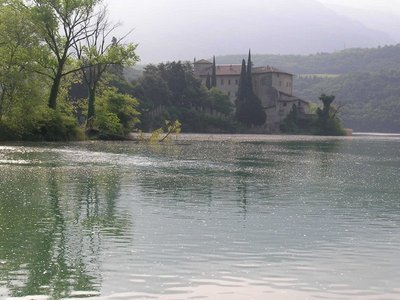
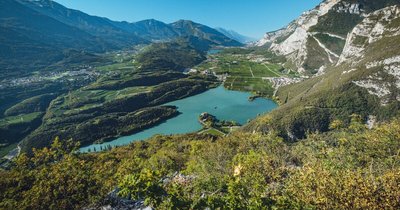
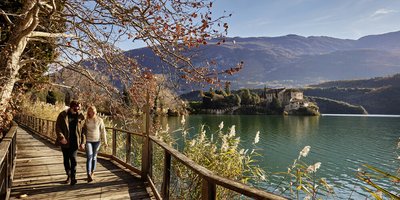
A lowland lake in the Sarca Valley, surrounded by a belt of wetland vegetation, mainly reed beds, and aquatic vegetation, including a few patches of water-lily beds with yellow water-lilies. The protected area also includes the hills surrounding the lake, which are of considerable naturalistic value due to the presence of a sub-Mediterranean type of vegetation favoured by the mild climate.
The reserve is also designated as a Special Area of Conservation (SAC) and is one of the protected areas that make up the Sarca River Park.
The mild climate gives rise to a sub-Mediterranean type of vegetation: thermophilous deciduous woodland, including downy oak (*Quercus pubescens*), hop hornbeam (*Ostrya carpinifolia*) and manna ash (*Fraxinus ornus*), alternates with dense holm oak (*Quercus ilex*) forests, a species typical of warm, dry Mediterranean environments.
Some species, such as bay laurel (*Laurus nobilis*), reach the northern limit of their distribution range here, giving the Toblino basin considerable phytogeographical value.
In the area surrounding the lake, typically Mediterranean cultivated plants also bear fruit, including lemon (*Citrus limon*), olive (*Olea europaea*), rosemary (*Rosmarinus officinalis*) and strawberry tree (*Arbutus unedo*).
Wetland and aquatic vegetation is poorly represented and, in the northern part of the lake, has been impoverished by the large inflow of cold water from Lake Santa Massenza.
The lake is home to a rich and diverse fish fauna and is an important breeding area for numerous species of waterbirds, which find shelter and nesting sites among the reed beds along the shores. These include the Cetti’s warbler (*Cettia cetti*), mallard (*Anas platyrhynchos*), common moorhen (*Gallinula chloropus*), Eurasian coot (*Fulica atra*) and the rare great crested grebe (*Podiceps cristatus*).
Even the grey heron (*Ardea cinerea*) has bred here, taking advantage of the small but quiet islet opposite the castle, and over the years has established a sizeable breeding colony.
Numerous bird species use the lake as a wintering site or as a stopover during migration.
A rich and diverse vertebrate fauna also finds shelter and food in the dense, luxuriant vegetation covering the slopes surrounding the lake.
| Location | Italy - Trentino-Alto Adige - Trento |
| Website | https://www.provincia.tn.it/Amministrazione/Luoghi/Aree-protette/Lago-di-Toblino2 |
| Area | 1.70km² |
| Year of foundation | 1996 |
| IUCN Category | IV |
| DtP ID | 04b36560-25cb-4623-a653-149f81a5e37c |
| Name and division |
Provincia autonoma di Trento
Servizio sviluppo sostenibile e aree protette |
| Website | https://www.provincia.tn.it/Argomenti/Ambiente/Biodiversita-e-aree-protette |
| Address |
Show address Hide address
Piazza Dante 15
38122 Trento Italy |
Horse riding is forbidden.


Motor vehicles are only allowed on public roads.

Water sport is forbidden.
Swimming is forbidden.

Camping is forbidden.

Air sport (starting and landing) is forbidden.

Disposing of waste is forbidden.

Fire is forbidden.

Dogs must be kept on a leash.

Collecting plants is forbidden.

Mushroom collecting is forbidden.

Collecting minerals and fossils is forbidden.


Fishing is only allowed at designated locations.
and during the time period indicated on the signs.

Using model vehicles on land and water is forbidden.